Introduction: The Reality of an Indiana January
Its 5:30 AM on a Monday in mid-January. You step out of your home in Halteman Village or perhaps leave your dorm near the Ball State Scramble Light, rushing to clear the overnight frost off your windshield. You’re already running late, the wind chill is biting through your coat, and then it happens: you slide your key into the lock, and it won’t budge. Or worse, you press the button on your smart lock, and instead of the familiar click, you hear a pathetic, strained whine of a motor struggling against ice.
In Muncie, Indiana, this isn’t just an inconvenience—it’s a seasonal rite of passage. With January temperatures often plummeting to a low of 19°F (and frequently dipping into the negatives during a Polar Vortex), our community faces a unique set of security challenges. A frozen lock is more than a delay; it is a safety risk that can leave you stranded in dangerous temperatures or lead to a broken key that costs hundreds of dollars to extract and replace.
Many well-meaning neighbors will offer advice—”Just pour some hot water on it!” or “Heat the key with a lighter!”—but as a professional locksmith serving Delaware County, I’ve seen these “quick fixes” turn a simple frozen cylinder into a permanent mechanical failure. This guide is designed to help Muncie residents understand why their locks are acting up and how to safely regain access without destroying their hardware.
Why Do Locks Freeze? (The Science of the Snag)
To solve the problem, we first have to understand the invisible battle happening inside your door. Muncie’s weather is notoriously “bipolar”—we often see a damp, rainy 40°F afternoon followed by a flash freeze that drops the temperature 20 degrees in three hours. This is the perfect recipe for lock failure.
The Role of Condensation and Humidity
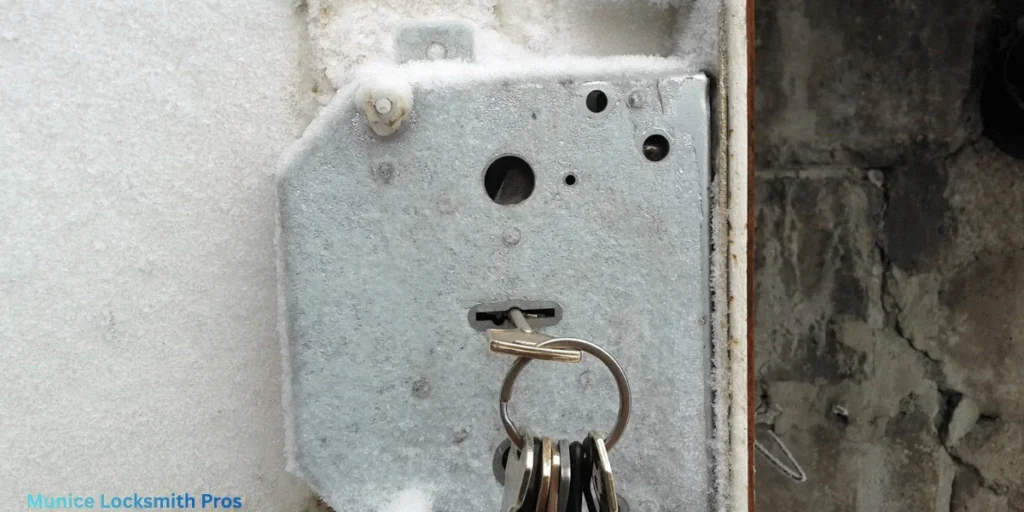
Indiana is a high-humidity state. Even in the winter, moisture hangs in the air. When the warm, humid air from inside your heated home seeps through the tiny gaps around your door, it hits the freezing cold metal of the lock cylinder. This causes condensation—tiny water droplets—to form inside the intricate “pin and tumbler” system.
When the temperature drops at night, that internal “dew” turns into a thin sheet of ice. Because the tolerances inside a high-quality lock are measured in fractions of a millimeter, even a microscopic layer of ice can “glue” the pins in place, preventing them from moving when you insert your key.
Differential Contraction: Metal vs. Wood
It’s not just about ice; it’s about physics. Most locks in Muncie are made of brass or steel, while many of our beautiful historic homes in the Emily Kimbrough district have solid wood doors.
- Metal Contraction: Cold causes metal to shrink. In extreme cold, the springs inside your lock become “stiff” and less responsive.
- Wood Swelling/Shrinking: Your door frame is likely made of wood, which reacts to Muncie’s humidity by swelling and to the dry furnace heat by shrinking.
This causes a misalignment. You might think your lock is “frozen” because the key won’t turn, but the reality is that the door frame has shifted just enough that the deadbolt is pressing hard against the strike plate. In January, the combination of ice inside the lock and a shifting door frame outside creates a “double jam” that can defeat even the strongest keys.
The “Gunk” Factor
Throughout a dusty Indiana summer and a rainy autumn, tiny particles of grit, salt, and old oil-based lubricants (like WD-40) build up inside your lock. In the summer, this “gunk” is a liquid or a paste. In a Muncie January, that paste thickens into a cement-like substance. When you combine frozen moisture with “frozen” dirt, you get a lock that feels completely seized.
By understanding that your lock is a precision instrument fighting against moisture, shifting wood, and thickened debris, you can see why “forcing it” is never the answer.
Moving forward, we are going to tackle the most critical part of the blog: debunking the dangerous “internet myths” and providing the safe, professional-grade solutions. This section adds deep value and establishes your authority by explaining the consequences of bad DIY habits.
The “Boiling Water” Trap: Why DIY Myths Are Dangerous
When you’re shivering on your porch in the Yorktown or Cowan area, desperation can lead to poor choices. We’ve all seen the viral videos or heard the “old-timer” advice, but as a locksmith who has replaced dozens of ruined cylinders in January, I need to set the record straight on why these common myths are a disaster for your security.
The Boiling Water Myth
It seems logical: ice is cold, so hot water should melt it. While a pot of boiling water will temporarily melt the ice inside your lock, it creates a much bigger problem seconds later.
- The Refreeze: You are introducing a massive amount of liquid into a freezing environment. Once the initial heat dissipates, that water flows into every tiny crevice of the lock body and the internal door mechanism. Within minutes, it refreezes into a solid block of ice that is much harder to clear than the original frost.
- Thermal Shock: Modern lock finishes (like Oil Rubbed Bronze or Satin Nickel) can crack or peel when exposed to sudden, extreme temperature changes. Even worse, if you have a smart lock, the steam and liquid can fry the delicate electronic circuit boards.
The Lighter and the Key
Another common suggestion is to use a lighter to heat up your metal key before inserting it.
- For Residential Keys: This is marginally safer but often ineffective because the key loses its heat the moment it touches the frozen metal of the cylinder.
- For Automotive Keys: Stop immediately. Most cars in Muncie today use “transponder” keys or “fobs” that contain a tiny computer chip. If you overheat the metal blade of your car key, you risk melting the plastic casing or frying the chip. If that happens, your car won’t start even if the lock turns, and you’ll be looking at a $200+ replacement fee for a new programmed key.
The Hairdryer Limitation
While a hairdryer is actually a safe way to thaw a lock, it’s rarely practical. Most people don’t have an extension cord long enough to reach from their kitchen to their driveway, and it doesn’t help you if you’re stuck in the parking lot at Muncie Mall.
Immediate Solutions: How to Safely De-Ice a Lock
So, if you can’t use fire or boiling water, what should you do? Here are the professional methods to get back inside your home or car safely.
The “Hand Warm” Method
If the freeze is minor, your own body heat can be your best tool.
- Cup your hands around the lock and blow warm breath into the keyway for about 30 seconds.
- Warm the key itself between your palms.
- Gently attempt to insert and turn. Pro Tip: Never “jiggle” the key violently. If it doesn’t turn with light pressure, stop.
The Role of Isopropyl Alcohol
Alcohol has a much lower freezing point than water. Carrying a small bottle of hand sanitizer (with at least 60% alcohol) can be a lifesaver.
- How to do it: Apply a small amount of sanitizer to your key and gently work it in and out of the lock. The alcohol will melt the ice and evaporate quickly without leaving behind moisture that could refreeze.
Chemical De-Icers
Commercial “Lock De-Icer” sprays are essentially pressurized alcohol with a tiny bit of lubricant. These are highly effective for Muncie winters.
- The Golden Rule: Keep the de-icer in your work bag, purse, or office desk. A can of de-icer sitting in the glove box of a locked car is useless when you’re standing outside in the snow!
Dry Lubricants: Graphite vs. Everything Else
Once the ice is gone, you need to prevent it from coming back.
- Dry Graphite: This is the gold standard. It comes in a small tube of powder. Because it is “dry,” it doesn’t attract dust or provide a base for water to cling to.
- Avoid “Wet” Lubricants: Stay away from standard WD-40 or cooking oils. These are “hygroscopic” (they can trap moisture) and will turn into a sticky sludge when the Delaware County humidity returns in the spring.
Automotive vs. Residential: Different Risks
A frozen door on a house is one thing; a frozen car door in a Muncie winter is a completely different beast.
The Frozen Gasket Problem
Often, it isn’t the lock that is frozen—it’s the rubber seal (gasket) around the car door. If your key turns or your fob clicks but the door won’t budge, do not pull with all your might. You can tear the rubber seal right off the frame, leading to wind whistles and leaks later. Instead, push on the door firmly to break the ice seal before pulling it open.
The “Snap” Risk
In sub-zero temperatures, metal becomes brittle. We see a spike in “Broken Key Extractions” every January in Muncie. If you feel the key start to flex or bend, stop immediately. It is much cheaper to call a locksmith for a thaw-out than it is to pay for an extraction and a new key cut from code.
Smart Locks in the Polar Vortex
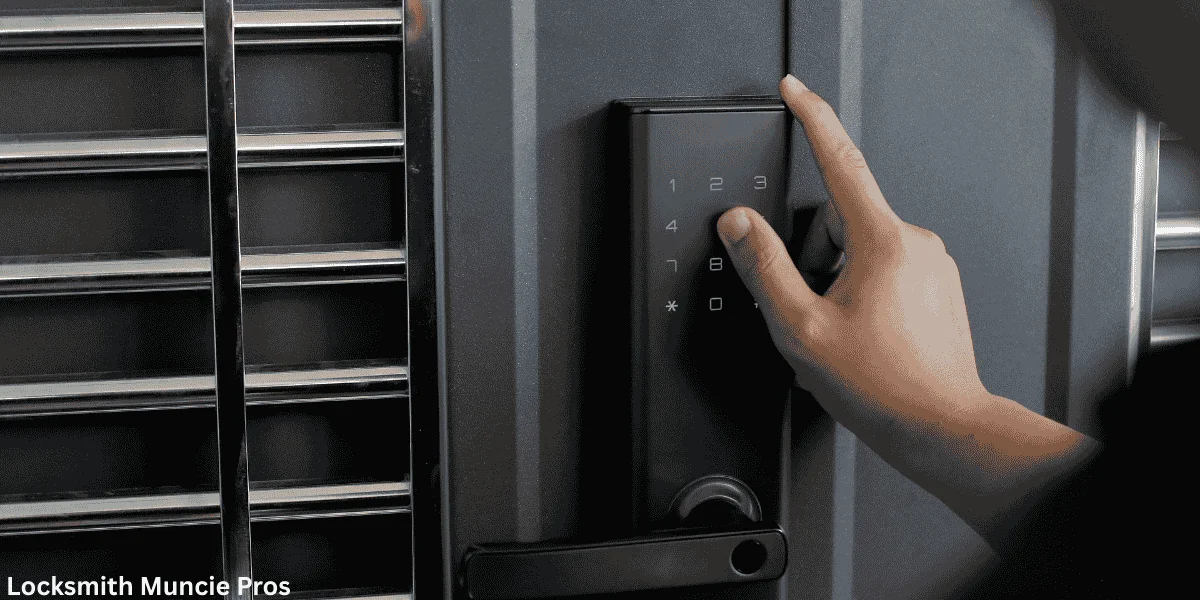
As Muncie becomes a more “connected” city, we see more smart locks in neighborhoods like Northwood and Old West End. While these devices offer incredible convenience, they are significantly more vulnerable to Indiana’s January weather than a traditional mechanical deadbolt.
The Battery Crisis: Chemistry vs. Cold
The most common “emergency” call we get in January isn’t actually a broken lock—it’s a dead battery. Most smart locks come standard with alkaline batteries. In temperatures below 32°F, the chemical reaction inside an alkaline battery slows down dramatically. When the temperature hits 0°F (a common occurrence in Delaware County), the battery can lose up to 50% of its capacity instantly.
- The Professional Advice: Switch to Lithium batteries for your smart locks. Unlike alkaline, lithium batteries are designed to operate in extreme environments (down to -40°F) and will ensure your motor has the torque needed to throw the bolt even if there is slight frost resistance.
The “Strained Motor” Syndrome
When ice builds up in the door strike, or when the door frame contracts due to the cold, the deadbolt may not align perfectly with the hole in the frame. A human can feel this resistance and “jiggle” the key. A smart lock motor, however, will simply try to force the bolt, fail, and then give you a “jammed” error.
- The Fix: Check your alignment now. If you have to pull or push on your door handle to get your smart lock to engage, you need a professional to realign the strike plate before the “Big Freeze” hits.
Touchscreens and Ice
Many residents at Ball State use keypad or touchscreen locks. In January, a thin layer of “black ice” can form over the screen, making it unresponsive to touch.
- Pro Tip: Always carry a physical backup key. If your smart lock doesn’t have a keyhole, ensure you know where the 9V emergency jumpstart posts are located on the bottom of the unit. A simple 9V battery touched to those posts can give you enough “juice” to enter your code if the internal batteries have died from the cold.
The Long-Term Solution: “Winter-Proofing” Your Security
Prevention is always cheaper than an emergency locksmith call at 2:00 AM on a snowy Saturday. Here is the definitive “Muncie Winter-Proofing Checklist” for your home and business.
The “Deep Flush” Cleaning
Throughout the summer and fall, Indiana wind carries pollen, dust from construction on McGalliard Road, and general road grit into your locks.
- What to do: Use a pressurized air can (like those for cleaning keyboards) to blow out the keyway. Follow up with a professional-grade dry lubricant. Avoid “oily” cleaners that will trap the next round of snow and turn into a “slurry.”
Weather Stripping and Moisture Barriers
The best way to keep a lock from freezing is to keep it dry.
- Check the Overhead: If your porch light or gutter is leaking water directly onto your door handle, that is where your ice is coming from.
- Inspect the Seal: If you can see daylight around your door, moisture is getting into the lock from the inside of the house. Replacing worn weather stripping from a local shop like Lowes or Menards can reduce the humidity that causes internal lock icing.
The “Key Inspection”
Take a look at your house key right now. Are the “teeth” rounded off? Is the key slightly bent?
- In the summer, a worn key works because the metal is warm and pliable.
- In the winter, that same key becomes brittle. January is the perfect time to have a fresh “master key” cut from code—not just a copy of a copy—to ensure the pins are lifted exactly to the right height, even when they are cold and stiff.
When to Call a Professional (Muncie Emergency Services)
There comes a point where DIY ends and professional intervention is required to save your door.
- The “Half-Turn” Jam: If your key goes in and turns halfway but then stops, do not force it. This usually indicates a broken internal spring or a displaced “wafer” that has been shattered by ice.
- The Snap: If you have already snapped the key, don’t try to “dig it out” with a screwdriver. You will likely push the fragment deeper and scratch the delicate internal warding, turning a $75 extraction into a $250 lock replacement.
- The Security Compromise: If your lock froze and you had to “jimmy” it open, your security is now compromised. The internal components may no longer be deadlocking, meaning a thief could easily slide your bolt back with a credit card.
Conclusion: Staying Warm and Secure in Delaware County
As we navigate the heart of another Indiana winter, it is easy to view a frozen lock as nothing more than a minor nuisance—a cold-weather tax we pay for living in the Midwest. However, your locks are the first and most critical line of defense for your family, your home, and your livelihood. Whether you are coming home from a late shift at IU Health Ball Memorial Hospital or heading out to a basketball game at Worthen Arena, you rely on your security hardware to work flawlessly, regardless of the temperature.
Muncie’s climate is unforgiving. The combination of high humidity, rapid temperature swings, and aging infrastructure means that our locks endure more stress than those in almost any other part of the country. By moving away from dangerous DIY myths like boiling water or open flames and embracing professional maintenance, lithium battery upgrades, and dry lubricants, you aren’t just preventing a lockout—you are extending the life of your home’s security system by years.
January 2026 is the perfect time for a “security reset.” Don’t wait for the next “Polar Vortex” to find out that your deadbolt is misaligned or your smart lock batteries are failing. Take a few minutes today to inspect your keys, lubricate your cylinders, and check your weather stripping. A little bit of preparation now can be the difference between a cozy evening inside and an expensive, freezing emergency on your front porch.
Don’t Get Left in the Cold: Your Local Muncie Security Partner
If you do find yourself facing a stubborn lock, a snapped key, or a smart lock that has finally given up against the Indiana frost, remember that you don’t have to solve it alone.
Locksmith Muncie Pros is proud to serve the Muncie, Yorktown, and Delaware County communities with 24/7 emergency winter services. We don’t just “pop locks”—we provide professional extractions, winter-proofed rekeying, and high-security upgrades designed specifically to withstand the Midwestern elements.
Your Winter Security Action Plan:
- Save Our Number: Program +1 877-311-8951 into your phone right now under “Locksmith” so you’re prepared before an emergency happens.
- Book a Winter Audit: Schedule a 15-minute “Lock Tune-Up” to have your home’s entry points lubricated and aligned for the season.
- Follow Us: Stay tuned to our blog for more hyper-local tips on protecting your Muncie property year-round.
Stay safe, stay warm, and keep Muncie secure.